Lien Waivers in Construction: What They Are and When to Sign Them (June 2026)
Learn what lien waivers are in construction, the four types, and when to sign each one. Complete guide for contractors updated June 2026.
It's easy to treat lien waivers like receipts: both show up at payment time, both get signed and filed away. But a receipt records a transaction while a lien waiver surrenders a legal right, and that distinction matters when a check doesn't clear. There are four types, split between conditional and unconditional, progress and final. The one that tends to catch contractors off guard is the unconditional final waiver signed before retention clears.
Once that's done, your lien rights are gone, even if the payment reverses shortly after. The stakes are high: payment delays now cost the U.S. construction industry an estimated $280 billion annually, roughly 14% added to total construction spending, according to the Rabbet 2024 Construction Payments Report.
TLDR:
- A lien waiver surrenders your legal right to file a mechanic's lien in exchange for payment.
- Four types exist: conditional or unconditional, progress or final. Never sign unconditional before funds clear.
- Six states require mandatory statutory forms. Using the wrong template can void your waiver entirely.
- Signing an unconditional final waiver before retention clears means you give up all lien rights permanently.
- Constructable tracks waivers alongside pay apps and change orders so you're not digging through inboxes at closeout.
What Is a Lien Waiver in Construction?
A lien waiver is a written document where a contractor, subcontractor, or supplier surrenders their right to file a mechanic's lien against a property. Signed in exchange for payment, it confirms the signer won't later claim unpaid labor or materials against the property title.
That's different from a receipt. A receipt records a transaction, while a lien waiver surrenders a legal right. If a check bounces after you've already signed one, that difference matters a lot.
A few parties view this distinction differently depending on where they sit in the payment chain.
- Property owners rely on lien waivers to protect against claims from subcontractors or suppliers they never directly hired and may not even know are on the job.
- General contractors deal with these documents in every payment cycle, collecting them from subs and suppliers to protect the owner and keep draws moving.
- Subcontractors and suppliers take on the most risk here. Signing one incorrectly, or before payment clears, can mean giving up legal protection they legitimately earned.
The Four Types of Lien Waivers
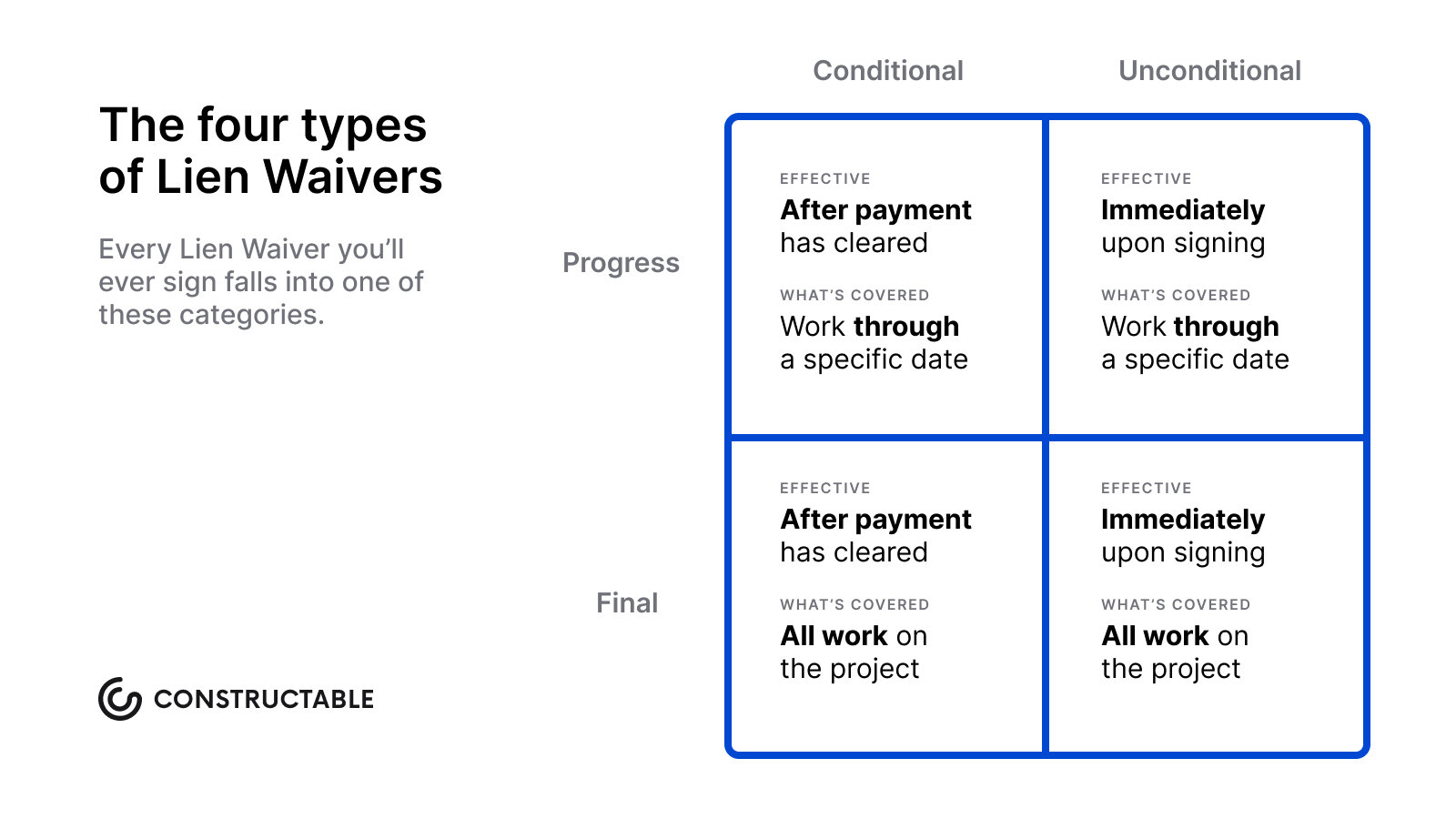
Every lien waiver falls on two axes: payment timing and project stage.
The first axis is conditional vs. unconditional. A conditional waiver only takes effect once payment actually clears. An unconditional waiver is effective immediately upon signing, regardless of whether the check ever cashes.
The second axis is progress vs. final. Progress waivers cover work completed through a specific date; final waivers release all rights for the entire project.
| Type | Takes Effect | Covers |
|---|---|---|
| Conditional Progress | After payment clears | Work through a specific date |
| Unconditional Progress | Immediately on signing | Work through a specific date |
| Conditional Final | After payment clears | All work on the project |
| Unconditional Final | Immediately on signing | All work on the project |
Cross those two axes, and you get four types. Every lien waiver you'll ever sign falls into one of them.
When to Use Each Type of Lien Waiver
Most contractors are familiar with the four types of lien waivers, but knowing which one applies to a given situation is only part of it. Timing is where things tend to go sideways. There are four common scenarios worth understanding, and the distinctions between them are more consequential than they might appear at first glance.
The Four Signing Scenarios
- Conditional progress waiver: Send this with your payment application before funds arrive. If payment falls through, the waiver never triggered, so your lien rights stay intact.
- Unconditional progress waiver: Sign only after the check actually clears. It confirms receipt of work completed up to a specific date and carries real legal weight.
- Conditional final waiver: This accompanies your last invoice. Safe to send while keeping your lien rights protected until funds actually land in your account.
- Unconditional final waiver: Sign this last, and only after every dollar, including retention, has cleared.
That last one is where contractors get burned. An unconditional final waiver permanently surrenders all lien rights. Once signed, there is no path back, even if a payment reverses days later.
State-Specific Lien Waiver Requirements
Lien waiver rules vary from state to state. A few states have mandatory statutory forms, and using the wrong one can void the waiver entirely.
States With Mandatory Forms
California, Nevada, Arizona, Utah, Wyoming, and Mississippi require contractors to use state-prescribed lien waiver language. In California, there are four required forms covering conditional and unconditional waivers for both progress payments and final payments. Using a homemade form in these states is a real risk.
States With No Mandatory Form
Wisconsin and Missouri fall into this category. You can use a template, but it must meet the state's basic legal standards. Always verify current requirements with a construction attorney in your state before signing anything.
Lien Waiver vs Lien Release
These two terms are constantly swapped, and the confusion is understandable. Both involve lien rights, but they operate at completely different stages.
A lien waiver is part of the normal payment cycle: you receive payment, you waive your right to file, and the property title stays clear throughout.
A lien release is different. It's a recorded document that clears a lien already on the title. By the time you need one, something has gone sideways: a payment dispute has escalated, a lien has been filed, and now that encumbrance has to be officially removed from the record.
Waivers are routine; releases are remedies. Signing a waiver when you actually need a release won't fix anything. The lien is already recorded. Only a properly filed release clears it, and that typically requires filing with the county recorder's office, not simply exchanging documents between the parties.
Common Mistakes When Signing Lien Waivers
Lien waivers are straightforward documents, but small errors can create big legal headaches. Knowing where people go wrong is half the battle.
- Signing before payment clears: a conditional waiver protects you if payment falls through, but signing an unconditional waiver before funds arrive means you've surrendered your lien rights with nothing guaranteed in return.
- Not matching the waiver type to the payment: using a final waiver for a progress payment wipes out your rights for all future work on that project, including the draw you received and everything beyond it. Proper financial management helps you accurately track these distinctions.
- Missing state-specific requirements: states like California and Wisconsin mandate specific statutory language, so a generic template may not hold up in court.
- Signing under pressure without reading: owners and GCs sometimes push for quick signatures at payment time; always confirm the dollar amounts, project description, and payment period before signing anything.
How Lien Waivers Flow Through the Payment Chain
On a typical construction project, lien waivers move in lockstep with payments across every tier of the construction payment chain.
Who Signs What
There are usually three or four parties involved:
- The general contractor signs a lien waiver to the owner when they receive payment.
- Subcontractors sign waivers to the general contractor when they get paid for their portion of the work.
- Suppliers and sub-subcontractors sign waivers to whoever is paying them directly.
Each party only waives rights for what they have actually been paid, which is why tracking waivers by payment event matters. Having real-time project cost and commitment visibility makes this tracking straightforward.
A Simple Example
When an owner pays the GC, the GC collects signed waivers from each subcontractor before releasing their checks, and each sub in turn collects waivers from their material suppliers before signing off to the GC. The chain closes at every level before money moves forward.
Automating Lien Waiver Management at Scale
Tracking waivers manually across one project is manageable. Across twenty, it's a different problem that construction management software is designed to solve. A mid-size GC running 15 to 20 active projects, each with many subs, can process thousands of waivers in a single year. That's exactly why the best software for mid-size contractors includes waiver automation.
Good waiver management software should do a few things well:
- Generate state-compliant forms, so you're not relying on a generic template where statutory language is required
- Track outstanding waivers by project and payment event
- Send reminders to subs who haven't signed yet
- Collect e-signatures and store them in a searchable audit trail
Missing waivers hold up draws. Automation is how you stop that from happening.
Managing Lien Waivers in Constructable
Lien waivers don't live in isolation. They're tied to pay apps, change orders, and the closeout process that wraps up a project. Better project management tools connect these pieces together.
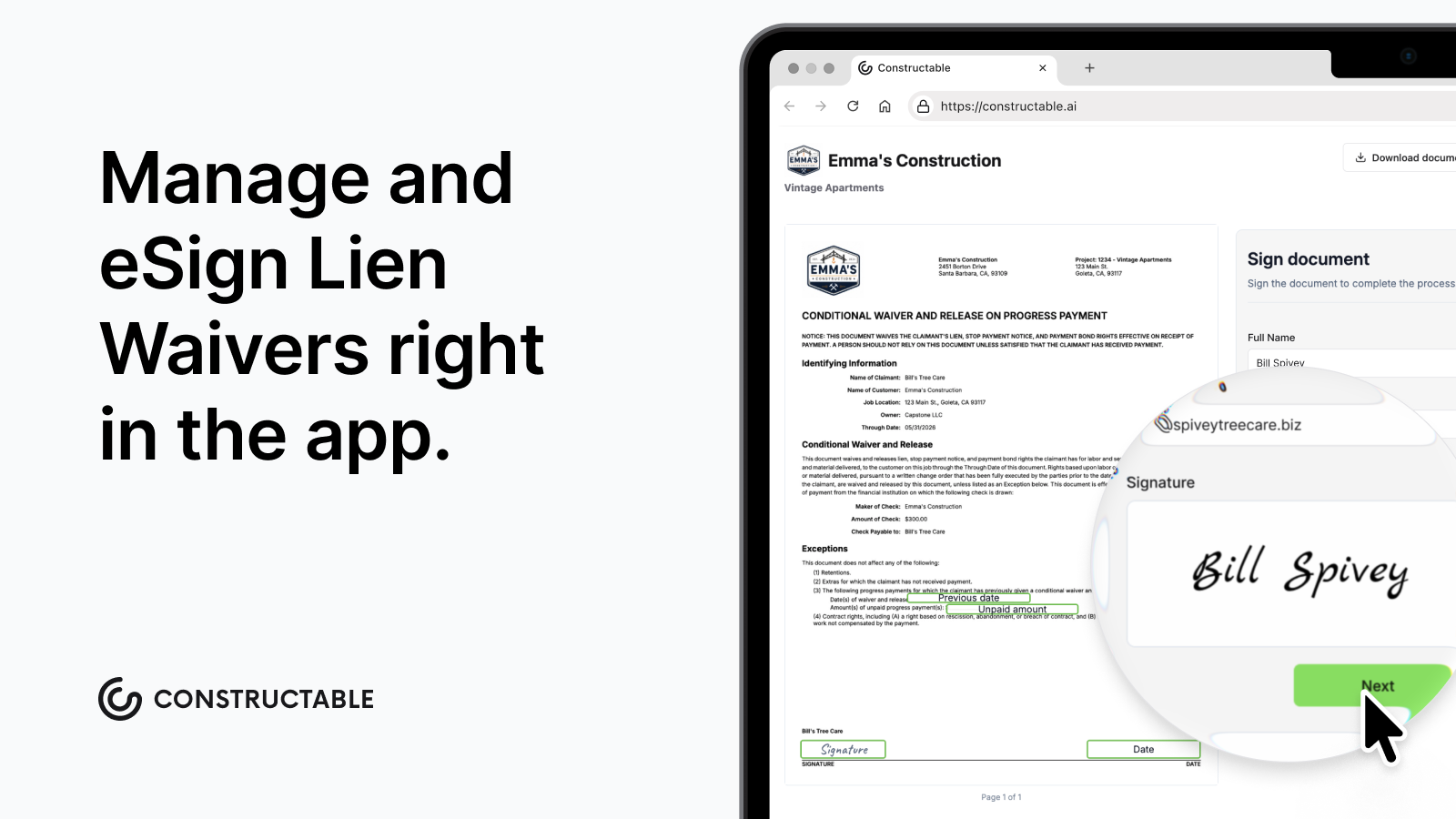
We built Constructable so those connections exist by default. Conditional waivers attach directly to payment applications, lower-tier waivers from subs and suppliers are tracked against the payment events they belong to, and waiver status stays visible alongside the financial workflows they're tied to. Constructable even lets Subcontractors eSign lien waivers directly in the app, which streamlines the entire process.
For mid-size GCs running several jobs at once, that matters more than it sounds. Tracking down a waiver signed six months ago shouldn't mean combing through inboxes. When waiver management lives in the same system as your daily logs, RFIs, and budgets, you're not toggling between five different tools to close out a pay period. The project is the context. Everything else follows from there.
Final Thoughts on Getting Lien Waivers Right
The difference between a lien waiver and a receipt is the difference between routine paperwork and surrendering legal rights. Most contractors know that, but the timing and type still trip people up when payments start moving. Conditional waivers give you protection until funds actually land, and unconditional ones take effect immediately, so signing the wrong one at the wrong time can cost you more than a bounced check ever would. Keep your waivers organized by project and payment event, and ensure you use state-compliant forms when required. If you're managing this across a dozen active jobs, we'd be happy to show you how waiver tracking works when it lives next to your pay apps and daily logs.
FAQ
Should I sign a lien waiver before payment clears?
Only if it's conditional. A conditional lien waiver protects your lien rights until the payment actually lands in your account—if the check bounces, the waiver never triggered. An unconditional waiver takes effect the moment you sign, regardless of whether you ever see the money.
What's the difference between a conditional and unconditional lien waiver?
Conditional waivers only take effect after payment clears, protecting your lien rights if the check bounces. Unconditional waivers are immediate: you surrender your legal claim the moment you sign, whether the payment clears or not.
What is a lien waiver used for in construction?
A lien waiver confirms that a contractor, subcontractor, or supplier has been paid and won't file a mechanic's lien against the property. Property owners require them to protect against claims from parties they didn't hire directly, and GCs collect them to keep payment draws moving.
Does my state require a specific lien waiver form?
It depends on where you're working. Six states require mandatory statutory forms: California, Nevada, Arizona, Utah, Wyoming, and Mississippi. Using a generic template in those states can void your waiver entirely. Most other states don't mandate a specific form, but your waiver still needs to meet that state's basic legal standards. When in doubt, verify current requirements with a construction attorney in your state before signing anything.
Can I fix a mistake after signing an unconditional final lien waiver?
No. Once you sign an unconditional final waiver, you've permanently surrendered all lien rights for that project, even if payment reverses later. This is why you should only sign after every dollar, including retention, has cleared your account.